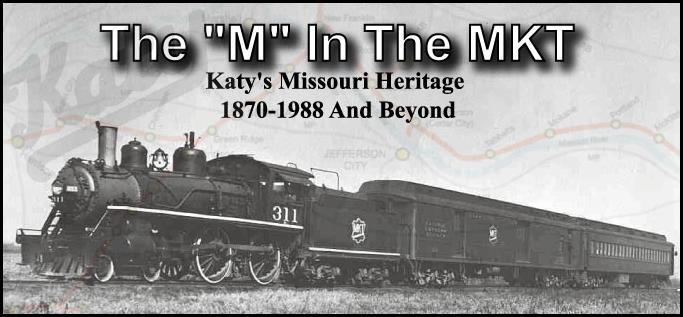
What came to be known as the Missouri Kansas Texas Railroad began life in 1865 as the
Union Pacific Railway (no corporate relation to the Union Pacific of today). Beginning
construction in 1869, the line was originally planned to run from Junction City, KS,
through Emporia to New Orleans, LA. One year later, the railroad changed its name to the
Missouri, Kansas & Texas Railroad to better reflect the pared-down goals of company management .
The beginnings of the MKT's Missouri lines actually began before the MKT
itself. In 1867, work began on the Tebo & Neosho Railroad, which was to have run from
Sedalia and Clinton, MO to Neosho in southwestern Missouri. Crews began building south from the
Pacific Railroad (later MP) in Sedalia in June of 1870, reaching Clinton in August,
and finally Nevada in October. In late 1870, the Tebo & Neosho was absorbed by the newly
formed MK&T.
And on February 3, 1871, the line from Sedalia finally reached it's parent MKT line in
Parsons, KS. From that point, the company pushed its rails south from Parsons into Indian
Territory (later the State of Oklahoma), reaching the State of Texas in December of 1872,
thus fulfilling the company's original vision of linking the States of Missouri and
Kansas with the State of Texas.
Back to the north, the Katy was not about to stop in Sedalia. The original goal of
the corporation was to
reach Chicago, and construction contiunued at a brisk pace in order to reach the Windy
City (and railroad capital of the world). By 1873, the MK&T had built northward from Sedalia
and Boonville to Hannibal, MO, on the Mississippi River, just a few hundred miles shy of
Chicago. Passenger and freight had to be ferried across the Missouri River at Boonville
until the railroad completed its first bridge at that location in 1873. As a result of
the completion of the Boonville bridge in January of 1874, through service was commenced
from Texas all the way to Chicago, via a connection with the Chicago, Burlington & Quincy
from Hannibal to Chicago. During this time, the MKT also commenced operations into St. Louis,
utilizing the trackage of the Missouri Pacific from Sedalia, through Jefferson City, to St.
Louis.
In 1880, the MK&T was leased to the Missouri Pacific Railroad, and it was operated
as a part of the immense MP/Jay Gould empire until 1888, when the lease expired and the
Katy resumed independent operation (the MP would later build it's own lines through
Oklahoma into Texas, some of which would later be abandoned by UP in 1988 in favor
of the original MKT lines!). During the MP years, the Katy was extended to Forth Worth,
Dallas, and Waco, TX.
On To St. Louis!
With St. Louis quickly rising as a major railroad gateway,
the recently-liberated MKT began shifting it focus to it and away from Chicago, though still
continuing operations to Illinois via the CB&Q connection at Hannibal. In the late 1890's,
the Katy created a subsidiary called the Missouri, Kansas, & Eastern Railroad to construct
a new line from the existing mainline at New Franklin, along the Missouri River, to Machens,
on the Mississippi River. From Machens, Katy trains could continue on to St. Louis via the CB&Q.
Unfortunately, in it's hurry to reach St. Louis, many construction "corners" were cut.
The poorly engineered line was constructed in the floodplain of the Missouri
River for much of its length. The new route, completed in 1895, would lead to millions of
dollars in losses and would prove to be an operational nightmare for many years to
come. Included on this new line was a new shops complex at the new
junction at New Franklin, a branchline to the city of Columbia and
the only tunnel on the MKT system, located in Rocheport.
Also in 1895, the MKT completed another new line from the St. Louis mainline at Bryson
(north of Windsor) to the KC mainline at Paola, KS. This line was envisioned to serve
as a through connector route for traffic between Kansas City and St. Louis, though
its rather circuitous route made for long transit times and prevented the MKT from
competing seriously in the trans-state rail market.
Next >>>