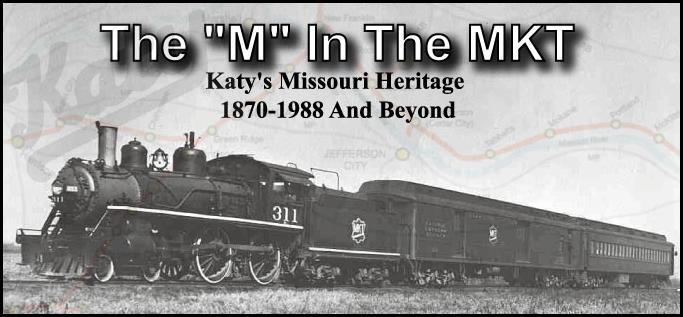
Through its early years, the Katy had periods of both struggle and prosperity,
though periods of struggle seemed to reign. In 1917, three passenger trains each
way traversed the St. Louis Sub. With it's hopes of ever reaching Chicago dashed by
financial struggles, the MKT sold the Moberly to Hannibal portion of its mainline to
the Wabash in the 1920's, providing the Wabash with a vital link in it's mainline to
Kansas City, and the MKT with much-needed cash. The line from New Franklin to Moberly
was then downgraded to secondary and branchline status.
In 1931-32, the MKT constructed a new lift-span bridge across the Missouri
River at Boonville, including a new girder span over the MoPac mainline on the south
bank of the river. The original bridge, though an impressive sight in itself, had not
been constructed to handle the heavier modern railroad equipment and was beginning to
deteriorate under the loads. At the time of its completion, the new bridge had the longest
railroad lift-span bridge in the world.
The years of the Great Depression brought years of decay for the
line. In 1933, passenger service between Parsons and St. Louis was
reduced to one train a day each way, provided by the "Katy Flyer".
However, World War II brought much-needed prosperity for the
MKT- and the railroad industry as a whole. But after
the war, the traffic began to dry up to pre-war levels and Katy returned to a
status of decline. In order to trim operating costs, the MKT implemented
cost cutting measures which included the abandonment of many miles of secondary and
branchlines and the discontinuance of the Katy Flyer passenger train on April 30, 1958
(in 1965, the
last MKT passenger run from Kansas City to San Antonio was finally axed). Also
in the late 1950's, the Walker-Eldorado Springs branch was dismantled, and in 1958,
the Bryson, MO to Paola, KS branch saw its last train and was abandoned.
Next >>