The End
During the 1980's, mega-mergers were created monster railroad systems.
Two of Katy's "neighbors" and important inter-line interchange partners had succumbed
to merger-mania: Burlington Northern took over the Frisco, and
MoPac was swallowed by the Union Pacific. The mergers severely dented
Katy's overhead traffic, resulting in great losses each year for the railroad. Coupled with
the overall economic recession and the financial stagnancy of the railroad industry as a whole,
the Katy was
left in a predicament: find merger partner or suffer severe financial losses and eventual
bankruptcy. Buring the 1960's and 70's, the Katy had been involved in seperate negotiations
to merge with the Southern, the Frisco, and the Chicago Great Western.
Rumor even has it the reason MKT management began painting the road's
locomotives and rolling stock in green in the 1970's was that it
was seeking to merge with the Burlington Northern, which itself was known
by its green locomotives and cars!
In 1986, the MKT managment's wishes finally came true when
Union Pacific approached MKT with the offer of a buy-out.
UP, which had added the
Western Pacific system and the MP's immense Midwestern
empire to it's belt earlier in the decade,
was interested primarily in Katy's Kansas City-Texas route.
Thus, after two years and several months of intense negotiations, on Friday, May 13th, 1988,
the Interstate Commerce Commission finally
granted the Union Pacific and Katy permission to consummate their
planned merger. Immediately after the approval, the two systems continued to
operate separately, but
by December of 1989 of that year, the merger was fully completed and signs of the Katy's
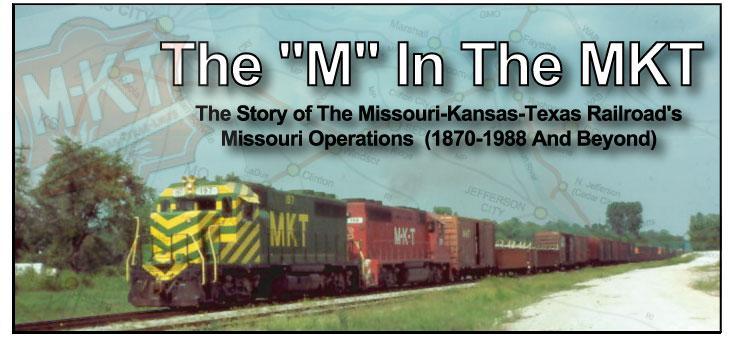
identity began to disappear. Trains on the Katy began to be pulled by Armour yellow UP
engines, and trains pulled by green MKT units became fewer.
While the buy-out meant salvation for the Katy system as a majority, it meant death and decline
to the remainder of the MKT operations in Missouri. For a brief period after the merger, Union
Pacific continued to operate former MKT daily trains 101 and 102 between St. Louis and
Dallas, via Sedalia and Parsons. However, being that UP already had it's
own major ex-MP mainlines from St. Louis to Texas, (via southeastern Missouri
and Arkansas) the MKT St. Louis Sub was deemed redundant. In early 1989, 101 and 102 made
their final runs, and became the
very last trains to traverse the 30 miles between Sedalia to Clinton. All ex-MKT St.
Louis traffic was simply
consolidated into other UP trains on its own lines, thus
rendering the ex-MKT through Missouri void of through traffic.
The line south of Sedalia sat silent
for many months after traffic was rerouted (UP continued to serve the middle Ft. Scott to
Clinton segment with a local train and the KCPL coal trains). Being
the rural Sedalia-Clinton had no customers, and
the line didn't figure into plans for through traffic,
Uncle Pete decided to abandon it. By 1991, the rails and ties were gone between
Clinton and Sedalia were gone
(the tracks between Parsons and Ft.Scott were removed about the same time).
A fixture of their daily lives for over 100 years,
towns such as Green Ridge, Windsor, and Calhoun would
lose their railroad for good. UP then donated the right-of-way to the State
of Missouri for an extension of the Katy Trail State Park.
Within the city of Sedalia,
the entire mainline through town was retained by UP for industrial switching purposes.
The MFA elevator on the south end of town and the Rhone-Puelanc chemical plant on the north
end of town justified
keeping the track in place.
89
As for the remaining "middle" segment (Ft. Scott to Clinton),
UP could still access and operate it via it's ex-MP Carthage
Subdivision, which crossed the old MKT at Nevada, MO. The sole salvation for the
line to Clinton was the Kansas City Power & Light power plant at Ladue, and it's need for
weekly coal
trains. In addition to the coal runs, UP locals continued to serve the on-line industries
and grain elevators on
an as-needed basis. Unfortunately, UP continued to make additional "prunings" to the line.
In 1991, it discontinued operations of the (ex-Frisco) "north stub" in Clinton. This
segment had been used by MKT since the Frisco retrenchment in 1980 to serve two grain
elevators on the north side of the city.
MNA Enters the Scene
In 1992, Union Pacific sold and leased it's
downgraded Carthage and White River Subdivisions to Railtex (now RailAmerica).
Railtex named this new operation the Missouri & Northern Arkansas Railroad (MNA).
Included in the package was the former MKT line from Ft. Scott through Nevada to
Clinton. Traffic patterns on the old MKT line changed little after MNA began operations;
the coal trains to LaDue continued to operate as usual, as did the as-needed-basis locals.
Downgrades/abandonments continued after MNA assumed operations. First of all,
MNA abandoned and tore out the northern-most three remaining miles of track,
between the former Frisco junction at Clinton to FPE Siding, which was the location of a
agricultural fertilizer distribution plant. The right-of-way between those
two points joined the rest of the abandoned St. Louis Division and was donated to the
Stare for the Katy Trailk.
The second downgrade occurred in 1997 after MNA moved
the LaDue coal
trains off the BN's Ft. Scott Sub and onto it's own parellel ex-MP lines into Nevada. Formerly,
the BN handed over it's
coal trains to the MKT at Ft. Scott, where they were then taken to Ladue
and vice-versa. After MNA moved the coal trains to its old MP lines, the old MKT
trackage from Ft. Scott to Nevada was rendered useless (no online customers and
interchage was already made with BN and several other locations).
MNA did keep the rails
in place, though
to store surplus rail cars. In 1998, BNSF (successor to the BN) finally removed
the inactive ex-MKT
crossing and diamonds in Ft. Scott, effectively severing the connection with the MNA.
Next >>